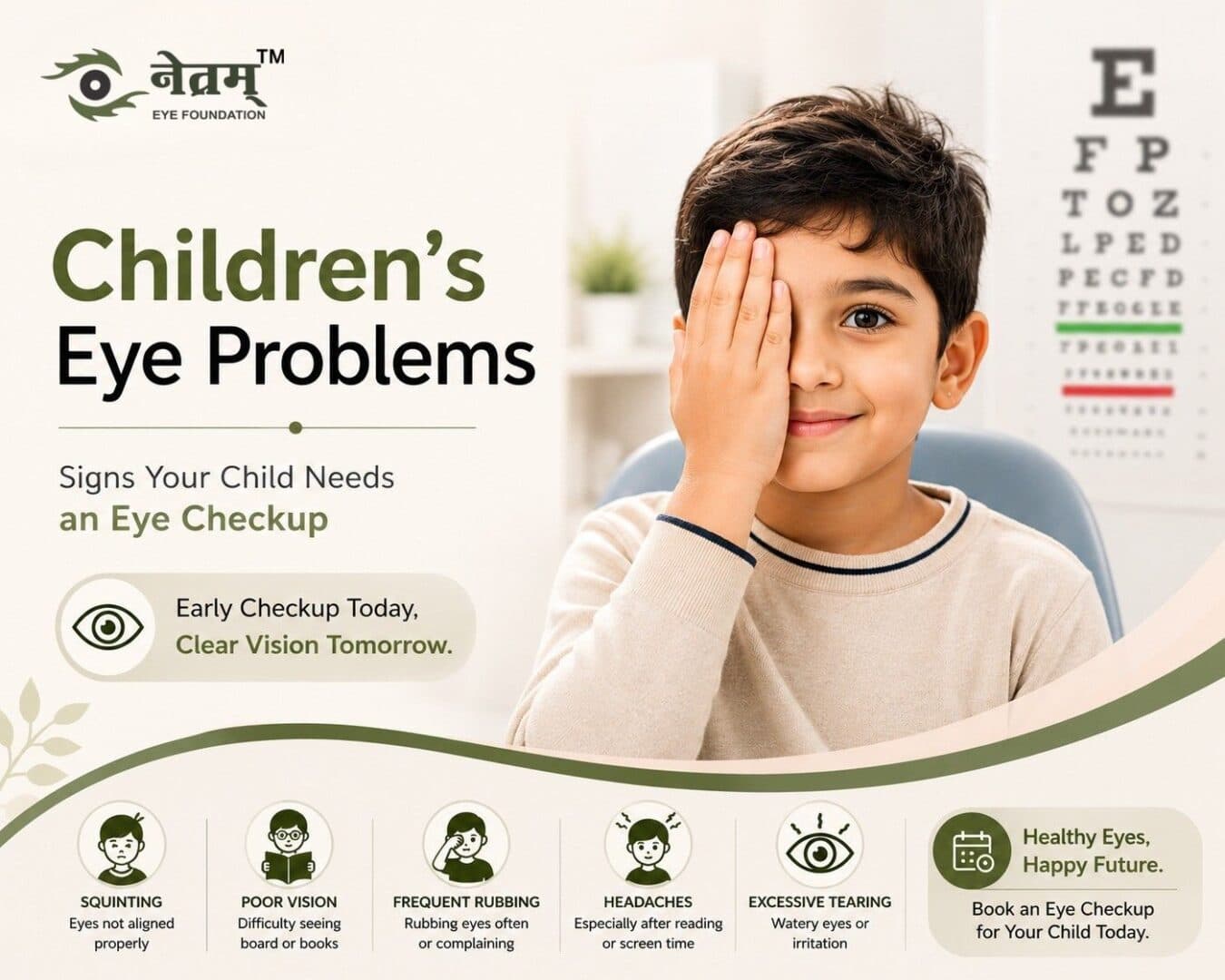
Children’s Eye Problems: 10 Warning Signs Your Child Needs an Eye Checkup
As a parent, you watch your child grow, learn, and explore the world. But how often do you think about how they are seeing that world? Good vision is the cornerstone of a child’s development, playing a vital role in their learning, social interaction, and confidence .Children’s Eye Problems however, many vision problems in children go undetected because kids often don’t realize they’re seeing poorly—they simply assume everyone sees the way they do. This is why recognizing the subtle signs of eye problems in children is so important for every parent.
This guide will walk you through the essential warning signs that indicate your child might need an eye checkup, covering common conditions and outlining the recommended schedule for professional eye exams to safeguard your child’s sight.
1. Squinting, Head Tilting, and Covering One Eye
One of the most obvious signs a child is struggling to see clearly is squinting. This is an instinctive action to try and improve focus by narrowing the eyelid opening. You might notice your child squinting at the television, the chalkboard at school, or even at a book. Similarly, tilting their head to one side or covering one eye while trying to focus are clear signs of a vision issue . They may be trying to compensate for poor vision in one eye or attempting to improve their visual alignment.
- What this could mean: These behaviors can be signs of refractive errors (like myopia or astigmatism) or strabismus (misaligned eyes). Head tilting can also be a sign of ptosis, a drooping eyelid that obscures vision .
2. Holding Objects or Screens Too Close
Does your child sit with their nose almost touching the television or hold a tablet incredibly close to their face? While it might seem like a habit, this is a strong indicator that they can’t see clearly from a normal distance. This is particularly common in children with myopia (nearsightedness), where distant objects appear blurry . This is one of the most common refractive errors in children and one of the easiest to correct with glasses.
3. Frequent Eye Rubbing
While children rub their eyes when tired, persistent and frequent eye rubbing is a red flag. It often indicates eye strain, fatigue from trying to focus, or irritation from allergies or an infection . If you notice your child rubbing their eyes a lot during or after activities that require visual focus—like reading, homework, or screen time—it’s a sign their eyes may be working too hard.
- What this could mean: Eye rubbing can be a symptom of refractive errors, conjunctivitis (pink eye), or allergic eye disease .
4. Frequent Headaches and Eye Strain
Young children may not be able to articulate that they have blurry vision, but they might complain of headaches, especially after reading or spending time on a screen. These headaches are often caused by the eye muscles working overtime to try and correct a vision problem, leading to eye strain. If your child is complaining of “heavy” or “tired” eyes, this is another related symptom to take seriously .
5. Poor Hand-Eye Coordination and Clumsiness
Vision is fundamental for developing good hand-eye coordination. If a child has poor depth perception or blurry vision, they may appear clumsy or uncoordinated. Watch for difficulty catching a ball, problems with writing or drawing, or frequently bumping into objects. These struggles can be a sign that their visual-motor skills are being impacted by an eye condition .
6. Red, Watery Eyes, Crust, or Discharge
Persistent eye redness, watering, or the presence of a crust or discharge on the eyelids is a sign that should not be ignored. While these can be symptoms of a minor infection like conjunctivitis (pink eye) or allergies, they can also indicate more chronic issues like a blocked tear duct or blepharitis . If your child has a “goopy” eye that isn’t improving, seek medical advice.
7. Misaligned Eyes (Strabismus)
If you notice that one of your child’s eyes turns inward, outward, upward, or downward while the other points straight ahead, this is strabismus, also known as a squint or crossed eyes. This misalignment can lead to double vision, which the brain often tries to fix by ignoring the image from the misaligned eye . This can in turn cause a “lazy eye” if not treated.
- What this could mean: Strabismus is a common condition in children that requires early detection and treatment to prevent permanent vision loss in the affected eye .
8. Sensitivity to Light (Photophobia)
Does your child seem unusually bothered by bright lights, sunlight, or flash photography? Do they often squint or shut their eyes even in moderate lighting? This sensitivity to light, known as photophobia, can be a sign of several issues, from refractive errors to more serious conditions like inflammation, cataracts, or glaucoma . If light sensitivity is accompanied by headaches or nausea, it warrants urgent attention.
9. A Short Attention Span or Poor School Performance
Vision problems are often misdiagnosed as learning or attention disorders like ADHD. If a child cannot see the board clearly or their eyes hurt when they try to read, it’s natural for them to become distracted, lose focus, or act out in class . If your child has a sudden drop in their grades, avoids reading or homework, or has trouble paying attention, an eye checkup should be your first step. Studies show that vision abnormalities can significantly contribute to learning difficulties .
10. A White Pupil Reflex in Photos
This is a critical sign to watch for, especially in photos taken with a flash. Normally, you see a “red-eye” effect, which is the reflection of the camera’s flash off the retina. If you see a white, gray, or yellow glow instead of a red one in one or both of your child’s eyes in a photograph, it is a serious warning sign. This can indicate a cataract, but it can also be a sign of retinoblastoma, a rare but serious childhood eye cancer .
- Urgent Action Required: This symptom requires a prompt and immediate appointment with an eye specialist.
The Critical Role of Comprehensive Eye Exams
It’s important to remember that a quick vision screening at school, while helpful, is not a substitute for a comprehensive eye exam. Children’s Eye Problems School screenings are designed to flag potential problems but often miss subtle issues and cannot diagnose conditions like amblyopia or strabismus .
A comprehensive eye exam by an ophthalmologist or optometrist is a more in-depth evaluation. It includes checking visual acuity, eye alignment, depth perception, and overall eye health, often involving dilating the pupils to get a clear view of the back of the eye.
Recommended Eye Checkup Schedule
Protecting your child’s vision starts with a regular schedule of professional eye exams. The American Academy of Pediatrics (AAP) and the American Optometric Association (AOA) provide clear guidelines :
- Infancy (Birth to 2 Years): A basic eye check at birth is recommended to look for any congenital issues. The first comprehensive eye exam should occur between 6 and 12 months of age .
- Early Childhood (3 to 5 Years): A comprehensive eye exam is recommended at least once between the ages of 3 and 5. This is a critical period to detect and treat amblyopia .
- School Age (6 Years and Older): Children should have a comprehensive eye exam before entering first grade and then annually thereafter . For children who are at risk (e.g., have a family history of eye problems, have a systemic disease affecting the eyes, or show signs of refractive errors), more frequent exams may be necessary .
Children with refractive errors should have their vision checked at least once a year by an eye doctor . If myopia is severe or worsening rapidly, more frequent checkups may be needed.
Common Children’s Eye Problems and Warning Signs
Understanding the most common pediatric eye conditions can help you better interpret the signs your child might be showing.
- Refractive Errors (Myopia, Hyperopia, Astigmatism): These are the most common vision problems. They occur when the shape of the eye prevents light from focusing directly on the retina, leading to blurry vision .
- Amblyopia (Lazy Eye): A condition where the brain favors one eye over the other, leading to reduced vision in the weaker eye. Early treatment is essential to prevent permanent vision loss .
- Strabismus (Misaligned Eyes/Squint): When the eyes point in different directions. It can be constant or intermittent and often leads to amblyopia .
- Conjunctivitis (Pink Eye): An infection or inflammation of the conjunctiva, causing redness, itching, and discharge .
Promoting Healthy Vision at Home
Beyond professional checkups, you can foster healthy vision for your child. A balanced diet rich in nutrients like Vitamin A, C, E, and Omega-3 fatty acids (found in leafy greens, eggs, and nuts) supports eye health . Limiting screen time is also vital. A 2025 study found that global childhood myopia has increased significantly, with projections that it will affect nearly 40% of children by 2050 . Children’s Eye Problems Encourage your child to spend at least two hours outdoors each day, as exposure to natural light is shown to reduce the risk of myopia. Experts recommend no screen time for children under 2 and less than an hour for those aged 2-5 .
Frequently Asked Questions (FAQs)
1. At what age should my child have their first eye exam?
The first comprehensive eye exam should be between 6 and 12 months of age . A basic check is done at birth. The second should be at age 3, and then before starting first grade, followed by an annual schedule.
2. How do I know if my child has a vision problem?
Look for behavioral signs like squinting, sitting too close to the TV, rubbing their eyes, turning their head to see, or complaining of frequent headaches. You may also notice a misaligned eye, poor hand-eye coordination, or an unusual white reflex in photos.
3. Is it possible for my child to pass a school vision screening but still have an eye problem?
Yes. School vision screenings are basic tests that check for clear sight at a distance (20/20 vision). They often miss refractive errors like astigmatism and are poor at detecting conditions like amblyopia or strabismus . A comprehensive eye exam is much more thorough.
4. What should I do if I notice a white reflection in my child’s eye in a photo?
This is an emergency. A white, gray, or yellow pupil reflex (instead of the normal red reflex) can be a sign of a serious condition like retinoblastoma (eye cancer), cataract, or other retinal issues. Seek an immediate evaluation from an eye specialist.
5. How much screen time is safe for my child’s eyes?
Experts recommend no screen time for children under 2 years and less than 1 hour of high-quality screen time for children aged 2-5 . Limiting screens and encouraging a “Blue Light Ban” (reducing screens from 6:30 pm onward) can protect sleep and eye health.
6. What is the difference between an optometrist and an ophthalmologist?
An optometrist is an eye doctor who provides primary vision care (checkups, prescribing glasses/contacts). An ophthalmologist is a medical doctor who specializes in eye and vision care and can perform eye surgery and treat all eye diseases. A pediatric ophthalmologist specializes in children’s eye care .
Conclusion
Your child’s vision is a precious gift that is fundamental to their learning, development, and quality of life. By being vigilant for the subtle signs of vision problems and committing to a schedule of professional eye exams, you can ensure they have the clear vision they need to succeed and explore the world around them safely. Children’s Eye Problems If you have any concerns about your child’s eyes or their development, don’t wait—talk to your pediatrician and schedule a comprehensive eye exam today.
Medically reviewed by Dr. Anchal Gupta, Netram Eye Foundation. This article is for general awareness and is not a substitute for a personal consultation.