Chalazion I&C (single) | Persistent meibomian gland cyst — not resolved with warm compresses | 10–15
min | Local
injection | An inner-lid incision is made, the chalazion contents are evacuated, and the walls are curetted. Material is sent for histopathology as standard. | A persistent chalazion not resolving after 4–6 weeks of warm compresses and lid hygiene, or one causing discomfort or cosmetic concern. | Mild swelling and bruising for 3–5 days; full resolution is usually seen over 2–4 weeks. |
Chalazion I&C (multiple) | Multiple cysts — same session | 20–30
min | Local
injection | The same inner-lid incision and curettage technique is carried out for more than one chalazion in the same sitting. | Multiple eyelid cysts present together and suitable to be treated in one clinic session. | Recovery is similar to single I&C, though swelling may be slightly greater depending on the number of cysts treated. |
Corneal Foreign Body Removal | Embedded corneal foreign body — metallic, stone, organic | 10–20
min | Topical
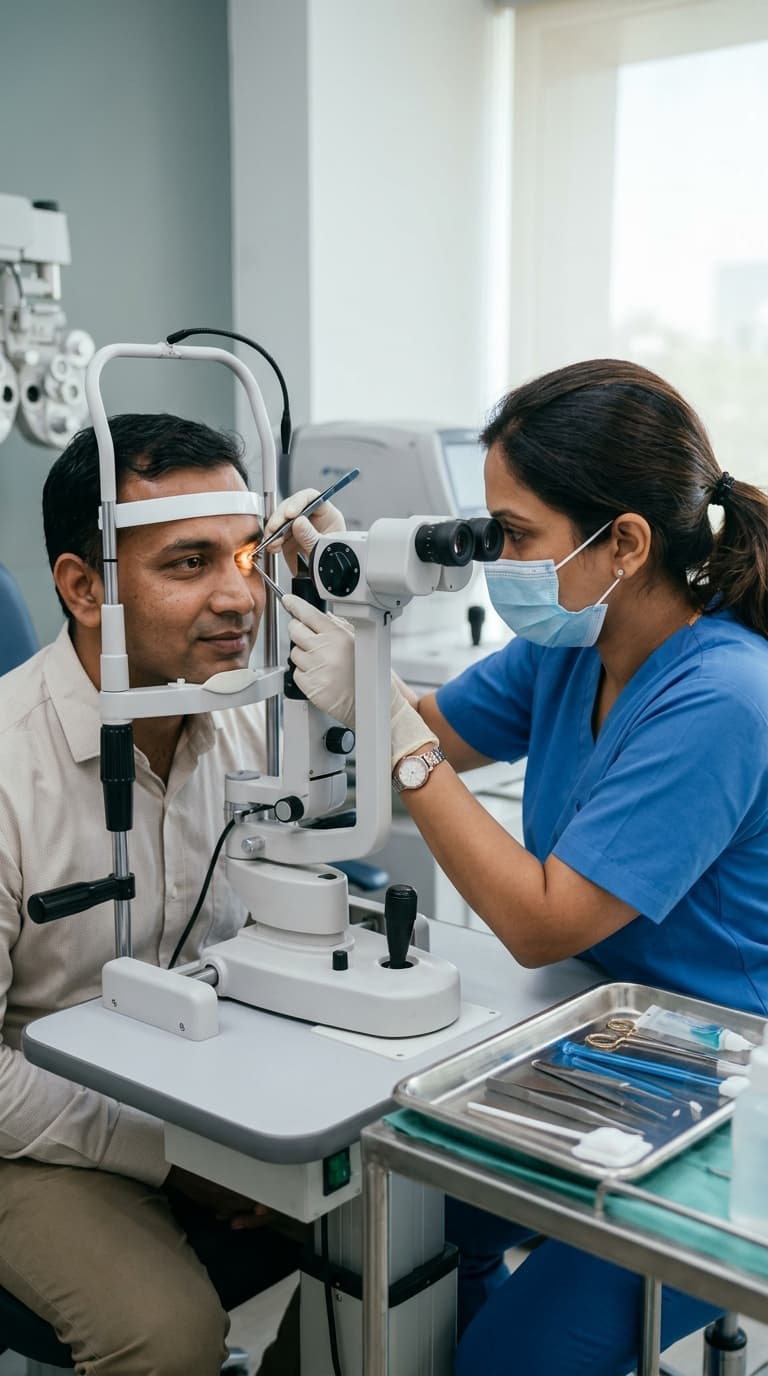
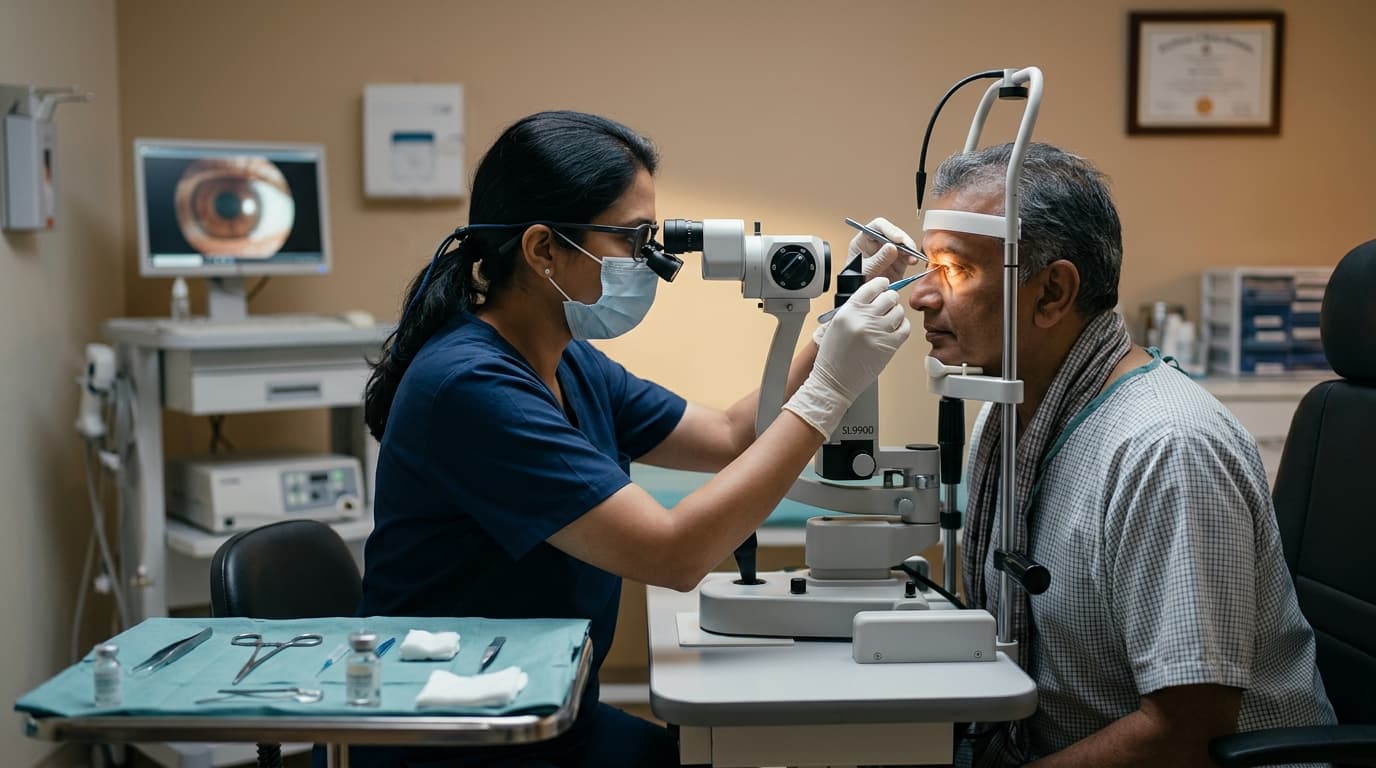
drops | Removal under slit-lamp magnification using a sterile hypodermic needle or ophthalmic spud after topical anaesthetic drops. | An embedded corneal foreign body causing pain, tearing, photophobia, or a sensation that does not wash out. | Most corneal abrasions heal within 24–48 hours. Early removal reduces stromal scarring. |
Corneal Rust Ring Removal | Iron rust ring following metallic foreign body | 10–15
min | Topical
drops | Iron staining left by a metallic foreign body is removed with a corneal burr (Alger brush), ideally in the same sitting. | A rust ring has formed after a metallic corneal foreign body, often within 24–48 hours. | Delay allows deeper stromal penetration and increases the size of the final scar. |
Epilation (Trichiasis) | Misdirected lash — temporary removal | 5–10
min | Topical
drops | The misdirected lash is removed manually with forceps to stop it rubbing on the cornea. | Temporary relief for one or a few aberrant lashes causing corneal irritation. | Relief usually lasts 4–8 weeks because the lash regrows. |
Electrolysis (Trichiasis) | Misdirected lash — follicle destruction, permanent | 10–20
min | Local
injection | Electrical current is applied to destroy the follicle of the offending lash and reduce recurrence. | For isolated lashes that keep returning after repeated epilation. | Better for permanent control than simple epilation, but some lashes may still need repeat treatment. |
Pterygium Excision + Autograft | Pterygium encroaching on visual axis or causing astigmatism | 30–45
min | Topical +
subconj. | The pterygium is excised from the cornea and the bare sclera is covered with a conjunctival autograft from the same eye, secured with sutures or fibrin glue. | When the pterygium encroaches on the visual axis, induces astigmatism, or causes chronic redness and irritation despite lubricants. | Autograft technique lowers recurrence to about 5–15%, versus much higher recurrence with bare sclera excision. |
Subconjunctival Injection | Antibiotic/steroid — keratitis, post-op inflammation | 5 min | Topical
drops | A fine-gauge needle delivers antibiotic, steroid, or antifungal medication directly into the subconjunctival space. | For severe keratitis, post-operative inflammation, episcleritis, scleritis, or when high local drug levels are needed. | A small bleb forms and usually absorbs over 24–48 hours; mild redness and discomfort are expected briefly. |
Intravitreal Steroid (Ozurdex / Triamcinolone) | Macular oedema, uveitis, refractory DMO | 10
min | Topical
drops | Steroid medication is administered into the vitreous cavity using full aseptic technique for retinal or inflammatory indications. | For macular oedema, uveitis, and refractory diabetic macular oedema where steroid treatment is clinically indicated. | Patients are monitored after the injection, including for pressure response where needed. |
NLD Syringing (Adult) | Epiphora — diagnostic and therapeutic | 5–10
min | Topical
drops | A lacrimal cannula is passed through the punctum and saline is syringed through the drainage system to confirm patency or localise blockage. | For adult epiphora as a diagnostic test and, in selected cases, a therapeutic irrigation. | This is a quick clinic procedure and the result helps guide whether further lacrimal surgery is needed. |
NLD Probing (Infant) | Congenital NLD obstruction — not resolved by 12 months | 15–20
min | GA /
sedation | Under brief general anaesthesia or deep sedation, a fine probe is passed through the nasolacrimal duct to open the membranous obstruction. | For congenital NLD obstruction that has not resolved by 12 months of age. | When performed before 18 months, probing is effective in roughly 80–90% of infants. |
Conjunctival Lesion Excision + Biopsy | Suspicious conjunctival lesion — papilloma, nevus, OSSN, melanoma | 15–25
min | Topical +
subconj. | Suspicious conjunctival lesions are excised with clear margins under topical and subconjunctival anaesthesia, and tissue is sent for histopathology. | For papilloma, nevus, OSSN, melanoma, or other lesions that are growing, atypical, or symptomatic. | Histopathology review at follow-up is essential because some ocular surface lesions are sight- or life-threatening if missed. |
Eyelid Lesion Excision + Biopsy | Eyelid growths — benign and suspicious | 15–30
min | Local
injection | Benign or suspicious eyelid growths are excised using fine instruments with haemostasis and specimen submission for histopathology. | For eyelid lesions that are enlarging, changing, symptomatic, or clinically suspicious. | Biopsy helps distinguish benign lesions from sebaceous or other periocular malignancy. |
Botulinum Toxin — Blepharospasm / HFS | Essential blepharospasm, hemifacial spasm | 10
min | None | Fine-gauge injections are placed at precise periocular and facial muscle points to reduce involuntary spasm. | For essential blepharospasm impairing function or hemifacial spasm confirmed clinically. | Effect begins in 3–5 days, peaks at about 2 weeks, and typically lasts 3–4 months. |
Anterior Chamber Paracentesis | Acute IOP emergency, aqueous culture for infection | 10–15
min | Topical +
subconj. | With full aseptic preparation, a fine needle or cannula enters the anterior chamber at the limbus and a measured amount of aqueous is aspirated. | For acute diagnostic sampling or urgent pressure reduction before definitive treatment in selected emergencies. | This is reserved for specific indications and is not used as a routine procedure. |
Xanthelasma Excision | Cholesterol deposits on eyelid skin | 20–30
min | Local
injection | The cholesterol-rich eyelid skin plaque is excised under local anaesthesia with careful eyelid skin handling. | For xanthelasma causing cosmetic concern or persistent prominence on the eyelid skin. | Recovery is usually straightforward, though recurrence can occur depending on the underlying lipid profile and lesion extent. |

 Chat on WhatsApp