Blurred Near Vision
The most common symptom is difficulty focusing on nearby objects. Activities such as reading, writing, or using smartphones may require greater effort to maintain clear vision.

■UNDERSTANDING THE CONDITION
Hyperopia is a refractive condition in which light entering the eye focuses behind the retina rather than directly on it. Because of this focusing error, the eye struggles to clearly see nearby objects and must work harder using its focusing mechanism (accommodation) to compensate, particularly during near tasks.
This usually occurs when the eyeball is shorter than normal or when the cornea is flatter than required for proper focusing. The eye's natural lens and ciliary muscle must constantly work to compensate, and in young people with flexible lenses, this compensation may be nearly complete — masking the condition until the visual demands increase or the focusing ability diminishes with age. This presentation pattern is frequently observed during consultations at an eye clinic in Delhi.
Hyperopia can occur at any age. Mild hyperopia is common in children and may improve as the eyes grow. However, moderate to high hyperopia can cause eye strain, headaches, and difficulty maintaining clear focus — symptoms that should be assessed and corrected for both comfort and visual performance.
Hyperopia primarily involves the cornea, crystalline lens, and axial length of the eyeball. When the eye is shorter than normal or the cornea is flatter, incoming light rays cannot converge on the retina and instead focus at a theoretical point behind it, causing near objects to appear blurred.
Hyperopia is a common refractive error primarily affecting near vision clarity. Key characteristics include:
■CLINICAL PRESENTATION
Symptoms of hyperopia vary depending on the degree of refractive error and the individual's ability to compensate using accommodation:
Blurred Near Vision
The most common symptom is difficulty focusing on nearby objects. Activities such as reading, writing, or using smartphones may require greater effort to maintain clear vision.
Eye Strain During Close Work
People with hyperopia often experience eye fatigue when performing prolonged near tasks. Continuous focusing effort leads to discomfort around the eyes or temples.
Frequent Headaches
Straining to focus on nearby objects may trigger headaches, particularly after extended reading, studying, or digital screen use.
Difficulty Maintaining Focus
Near text may appear temporarily clear but quickly becomes blurred or uncomfortable — the focusing effort required is tiring and unsustainable for long periods.
Squinting While Reading
Squinting may temporarily improve near vision by creating a pinhole effect that reduces the blur from unfocused light.
Burning or Tired Eyes
After prolonged visual tasks, the eyes may feel tired, irritated, or heavy due to the constant accommodative effort required to maintain focus.
These symptoms require prompt evaluation to rule out significant hyperopia or associated conditions:
Sudden Vision Changes
Immediate evaluationAny sudden change in vision should be evaluated promptly to rule out other eye conditions beyond refractive error.
Double Vision
Same day evaluationUncorrected high hyperopia may lead to double vision due to excessive accommodative convergence straining the eye muscles.
Crossed Eyes or Eye Turn in Children (Accommodative Esotropia)
Same day evaluationIn children, uncorrected hyperopia can cause one eye to turn inward during near focusing — this requires urgent assessment to prevent amblyopia.
Severe or Persistent Blurred Vision
Within 1 weekIf blurred near vision significantly interferes with daily activities such as reading, studying, or work tasks, a comprehensive eye examination is recommended.
Persistent Eye Strain Despite Rest
Within 1 weekContinuous eye fatigue that does not resolve with rest may indicate uncorrected hyperopia requiring updated optical correction.

Ask yourself these questions to determine if medical evaluation is needed:
If you answered "yes" to any of these questions, schedule a comprehensive eye examination with an eye care specialist in Delhi to determine whether hyperopia is present and obtain appropriate correction.
■TRIGGERS & ROOT CAUSES
While hyperopia is primarily caused by structural characteristics of the eye, certain lifestyle factors can exacerbate symptoms:
Prolonged Near Work
ModerateLong hours of reading, writing, or computer work increase visual demand on the eye's focusing system. Individuals with hyperopia must exert extra effort and may experience increased fatigue and discomfort.
Excessive Digital Device Use
ModerateFrequent use of smartphones, tablets, and computers at close distances increases the accommodative workload for hyperopic eyes, potentially worsening eye strain and visual fatigue.
Continuous Reading Without Breaks
ModeratePerforming near tasks for extended periods without rest may overwork the eye's focusing mechanism, leading to headaches and eye discomfort in hyperopic individuals.
Poor Reading Posture
LowReading materials held too close or improper posture while studying can increase focusing demand. Maintaining appropriate reading distance helps reduce associated strain.
Inadequate Lighting Conditions
LowReading or studying in dim lighting forces the visual system to work harder, increasing eye fatigue and discomfort particularly in individuals with uncorrected hyperopia.
Intensive Educational Demands
LowStudents with sustained academic activities requiring near vision tasks may experience significant visual strain if hyperopia remains uncorrected.
Specific structural characteristics of the eye determine the degree of hyperopia:
Shorter-Than-Normal Axial Length
The most common anatomical cause — a shorter eyeball causes light rays to focus at a point behind the retina rather than on it.
Flatter Corneal Curvature
A cornea with insufficient curvature cannot bend light steeply enough to focus it on the retina, contributing to farsightedness.
Genetic Predisposition
Children with parents who have hyperopia have a higher likelihood of inheriting the ocular structural characteristics that cause farsightedness.
Age-Related Accommodative Decline
As the eye's focusing ability decreases with age (presbyopia), any underlying hyperopia becomes increasingly symptomatic and less easily compensated.
Visual Stress from Modern Lifestyles
Extensive near work and digital device use increase visual workload on the accommodative system, particularly in individuals with significant hyperopia.
Certain conditions may be associated with or influence hyperopia:
Nanophthalmos
An unusually small eye (nanophthalmos) is typically highly hyperopic and also carries significant risk of angle closure glaucoma requiring careful monitoring.
Accommodative Esotropia
In children with significant uncorrected hyperopia, the excessive accommodative effort can trigger inward eye turning (esotropia), requiring glasses and potentially patching therapy.
Aphakia
Absence of the natural crystalline lens (following cataract surgery without IOL implantation) results in high hyperopia requiring optical correction.
Retinal Conditions
Certain retinal disorders such as macular oedema can cause acquired hyperopia due to physical displacement of the macula.
■CLINICAL EVALUATION
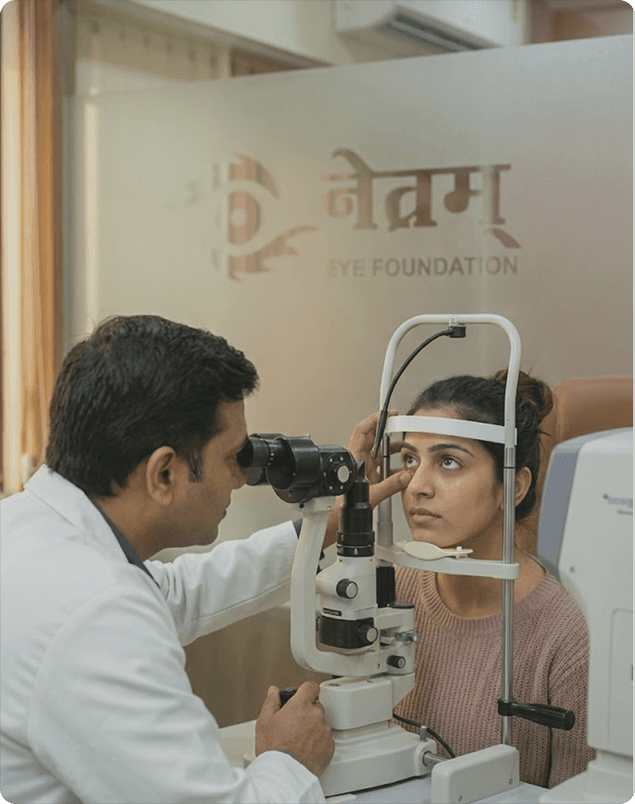
Hyperopia is diagnosed through a comprehensive eye examination using accurate optical measurement equipment:
■MANAGEMENT & TREATMENT
Use Corrective Eyewear
Prescription glasses or contact lenses help focus light correctly onto the retina, reducing visual strain and restoring comfortable near and distance vision.
Follow the 20-20-20 Rule
Every 20 minutes of near work, look at an object 20 feet away for 20 seconds to relax the focusing muscles and reduce accommodative fatigue.
Maintain Proper Reading Distance
Keep reading materials and screens at an appropriate distance (typically 40–50 cm for near tasks) to reduce the accommodative demand on the eye.
Ensure Adequate Lighting
Good lighting conditions improve visual clarity and reduce the additional effort required by hyperopic eyes to maintain focus during near tasks.
Limit Continuous Near Screen Use
Taking regular breaks from digital screens, especially during prolonged reading or work sessions, helps reduce visual fatigue and headaches.
Schedule Regular Eye Exams
Routine eye examinations ensure that spectacle prescriptions remain accurate and allow monitoring of any changes in refractive error over time.
Spectacle Correction (Plus Lenses)
First-line treatmentConvex (plus) lenses in glasses converge light before it enters the eye, effectively compensating for the focusing deficit and restoring clear near vision.
Contact Lenses
For contact lens wearersSoft or rigid gas-permeable contact lenses prescribed with plus correction provide comfortable vision correction without the limitations of spectacle frames.
Laser Vision Correction (LASIK / PRK / LASEK)
For permanent correction in eligible adultsLaser refractive procedures reshape the cornea to add curvature, correcting the underlying hyperopia and potentially eliminating the need for glasses or contacts.
Phakic Intraocular Lens (ICL)
For high hyperopia not suitable for laserImplantable collamer lenses placed inside the eye correct high levels of hyperopia in patients whose corneal thickness is insufficient for laser correction.

■SURGICAL INTERVENTION
Surgery is not required for hyperopia — glasses and contact lenses provide effective correction. However, for adults who wish to reduce or eliminate dependence on optical correction, laser refractive procedures such as LASIK, LASEK, or PRK can reshape the cornea to compensate for the farsighted prescription. For patients with very high hyperopia or thin corneas unsuitable for laser treatment, implantable collamer lenses (ICL) offer an excellent alternative.
Pre-operative assessment including corneal topography, pachymetry, and aberrometry is essential to confirm suitability and plan precision correction. At Netram Eye Foundation in Delhi, advanced refractive surgery diagnostics and surgical expertise allow accurate, personalised treatment planning to achieve the best possible visual outcomes for patients with hyperopia.
■ALL YOUR QUESTIONS ANSWERED
Hyperopia occurs when the eyeball is shorter than normal or the cornea has insufficient curvature to bend light steeply enough to focus it on the retina. As a result, light entering the eye converges at a point behind the retina, causing blurring of near objects. Genetic factors play a significant role — hyperopia often runs in families. In many young children, mild hyperopia is normal as the eye grows, and most outgrow it by early adulthood.
Hyperopia may change over time. In children, mild hyperopia often improves as the eye grows. In adults, the condition tends to remain relatively stable but can become more symptomatic as the eye's natural focusing ability (accommodation) decreases with age — a process that begins in the 40s (presbyopia). As the lens becomes less flexible, the eye can no longer compensate as easily for the farsighted error, and symptoms such as blurred near vision and headaches may become more noticeable.
Yes. Laser refractive procedures such as LASIK, LASEK, or PRK can permanently correct hyperopia by reshaping the corneal curvature. Implantable collamer lenses (ICL) provide an excellent option for those not suitable for laser treatment. However, even after refractive surgery, age-related presbyopia may still require reading glasses later in life. Patients should discuss their specific needs and realistic expectations with their ophthalmologist before proceeding with any surgical option.
Yes, genetic factors play a significant role in the development of hyperopia. The axial length of the eye — which largely determines the degree of hyperopia — is strongly influenced by hereditary factors. Children of hyperopic parents have a higher likelihood of developing the condition. However, the degree of hyperopia can vary considerably even within the same family.
Yes. Mild to moderate hyperopia is very common in children. In fact, most infants are born slightly farsighted, which typically resolves as the eyes grow. However, significant uncorrected hyperopia in children can cause eye strain, difficulty concentrating during near tasks, and — most importantly — accommodative esotropia (an inward eye turn) and amblyopia (lazy eye). Early detection through pediatric eye examinations is important to prevent these complications.
Laser vision correction for hyperopia is safe and effective when performed on appropriately selected patients by experienced surgeons. Pre-operative screening including corneal topography, thickness measurement, and wavefront analysis ensures patient suitability. Compared to myopia correction, hyperopia treatment typically requires a slightly larger ablation zone and may have a somewhat slower visual recovery. Potential side effects such as regression, dry eyes, or halos are manageable in most cases. Your ophthalmologist will advise whether you are a suitable candidate.
Still have questions? Our team is here to help.
Schedule Consultation
REQUEST AN APPOINTMENT